
Why PPT Exists
Most patients don’t understand gum disease until it’s too late—and most dental teams don’t have a consistent, visual way to explain it.
Traditional perio charting can feel abstract and confusing to patients. The result? Missed diagnoses, low case acceptance, and inconsistent standards between providers.
The PPT System was designed to fix that.
It turns periodontal care into a clear, visual, and structured process that anyone in the practice can understand and present confidently.
How the System Works
Every patient is categorized into one of four color-coded stages—each representing a distinct level of gum health and corresponding treatment pathway.
| PPT Stage | Color | Condition | Primary Focus |
|---|---|---|---|
| PPT 1 | 🟡 Yellow | Gingivitis | Prevention and inflammation control |
| PPT 2 | 🟠 Orange | Mild Periodontitis | Early intervention and risk management |
| PPT 3 | 🔴 Red | Moderate Periodontitis | Active therapy and tissue stabilization |
| PPT 4 | 🟣 Purple | Advanced Periodontitis | Comprehensive care and systemic connection |
Each stage includes its own patient folder containing tailored resources:
- Smile Report Card — A visual overview of the patient’s gum health.
- Risk Factor Management Sheet — Links lifestyle and systemic factors to periodontal risk.
- Gum Disease in Plain Terms — Simplifies complex clinical concepts.
- Recovery & Maintenance Guide — Encourages compliance and follow-through.
- Diet Log & Home-Care Challenges — Adds accountability and engagement.
Why It Works
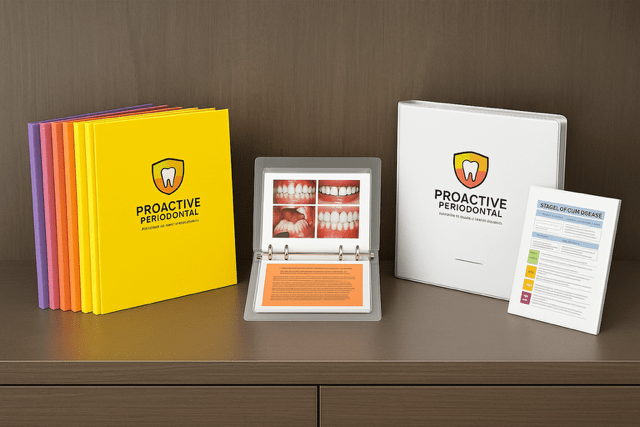
The PPT System bridges clinical precision with emotional communication.
✅ Visual impact: Color and emotion replace confusing numbers.
✅ Consistency: Every provider diagnoses and communicates the same way.
✅ Clarity: Patients understand their condition instantly.
✅ Scalability: Easy to train, easy to replicate across multiple locations.
✅ Profitability: Elevates hygiene from a routine “cleaning” department to a predictable production engine.
For Your Team
- Doctors: Gain consistency, calibration, and leadership clarity.
- Hygienists: Follow a simple roadmap for diagnosis and education.
- Treatment Coordinators: Present perio treatment with confidence and visuals.
- Patients: Finally understand their condition, take ownership, and say “yes” to care.
Measure What Matters
With the PPT framework, offices track KPIs like:
- Periodontal treatment percentage (target: 30–40%)
- Hygiene production per day ($2,000–$2,500)
- Reappointment rate (90–95%)
- Adjunctive service rate (20–30%)
These metrics ensure the hygiene department drives both clinical outcomes and practice growth.
Transform Your Hygiene Department
When fully implemented, the PPT System turns hygiene into a predictable, data-driven, and patient-inspiring department.
Every chart, every folder, every conversation moves patients toward health—and the practice toward growth.
Start Implementing PPT in Your Office
Ready to see how it works?
EXPLORE THE NEXT ESSENTIAL SYSTEM FOR YOUR PRACTICE
The 12 Essential SOPs Manual
Stop Repeating Yourself. Start Building a Team That Knows What to Do.
Your Practice Shouldn’t Have to Start Over Every Time You Hire Someone.
Does this sound familiar?
You spend weeks training a new employee, only to discover they’re doing things differently from how you explained them. Your experienced employees are constantly interrupted to answer the same questions. And when someone leaves, much of the knowledge and training you invested in walks right out the door with them.
Even more frustrating? Two employees can receive training for the exact same position and end up doing the job completely differently.
The problem isn’t always your people. It’s the absence of a reliable system.
At Genius Dental Systems, we believe a successful dental practice shouldn’t depend on how much information your best employees can remember—or how many times you’re willing to repeat yourself.
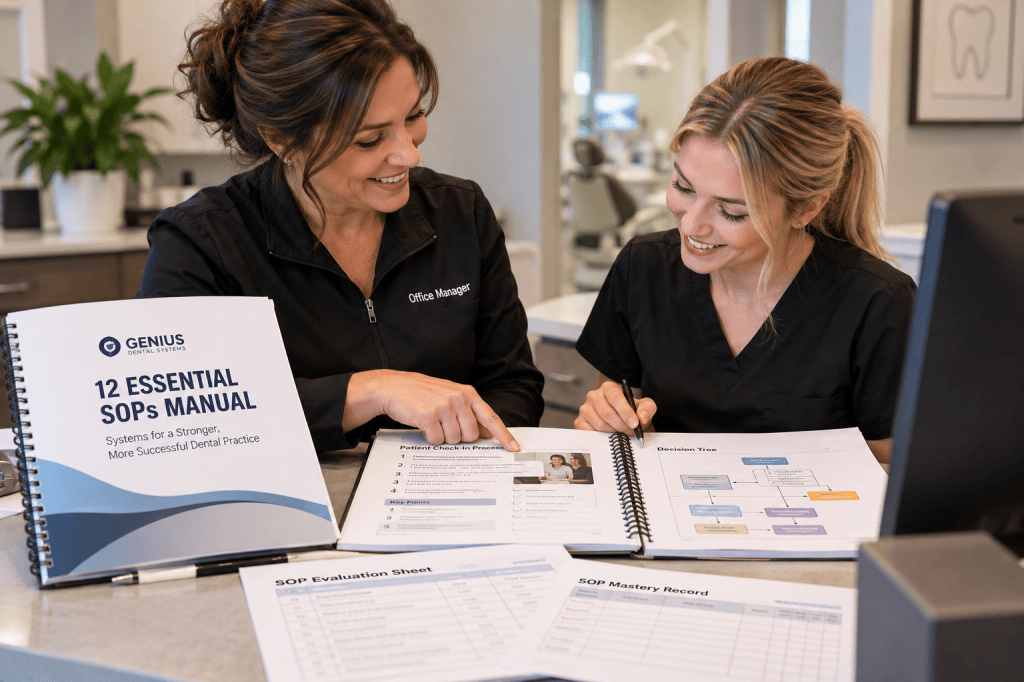
That’s why we created the 12 Essential SOPs Manual: a practical training and accountability system designed to help dental practices establish consistency, develop confident employees, and reduce the daily burden of managing through constant reminders.
Not Just Instructions. A System for Getting Things Done Right.
Most offices have some form of training. The problem is that much of it happens verbally, inconsistently, and in the middle of an already busy workday.
One employee explains a task one way. Another teaches it differently. Before long, the practice has several versions of the same procedure, and nobody is quite sure which one is correct.
The 12 Essential SOPs Manual helps replace that uncertainty with clear expectations and repeatable processes.
Inside the manual, you’ll find:
- 12 essential Standard Operating Procedures: Clearly organized instructions for important day-to-day practice responsibilities.
- Step-by-step workflows: Practical guidance that makes procedures easier to understand, teach, and repeat.
- Patient communication scripts: Consistent language that helps employees handle important conversations with greater confidence.
- Decision trees: Guidance for situations where employees need to make decisions, reducing unnecessary interruptions and guesswork.
- Checklists: Simple tools that help prevent overlooked steps and reinforce consistent execution.
- Knowledge assessments and evaluation sheets: Tools to determine whether employees truly understand the material and can demonstrate what they’ve learned.
- Individual SOP mastery records: A structured way to document training progress, identify weaknesses, and recognize when an employee is ready for greater independence.
Finally, a Way to Know Whether Your Employees Actually Learned It.
One of the biggest weaknesses in traditional staff training is that we often confuse explaining something with teaching it successfully.
Just because an employee attended a training session doesn’t mean they understood it. And just because they understood it doesn’t mean they can perform it correctly.
That’s where our evaluation system makes the difference.
Each SOP is designed to support a process of learning, practicing, and demonstrating competency.
Instead of relying on assumptions, managers can use evaluation sheets to identify what an employee understands, where additional coaching is needed, and whether the expected standard has been achieved.
This creates something many practice owners have been missing: measurable accountability.
Training becomes less subjective. Expectations become clearer. And conversations about employee performance can focus on documented standards rather than personal opinions.
Imagine What Your Practice Could Look Like.
Imagine welcoming a new employee without having to reinvent your entire training process.
Imagine your office manager having a clear roadmap for onboarding instead of figuring things out as they go.
Imagine employees being able to find answers without interrupting the doctor every few minutes.
And imagine knowing that the systems you’ve worked so hard to develop will remain in your practice, even when team members change.
That’s what building a systems-driven practice is all about.
Your Practice Deserves Systems That Outlast Your Employees.
You have invested years developing your clinical skills, building your reputation, and creating a practice you’re proud of.
Your daily operations deserve that same level of attention.
The 12 Essential SOPs Manual helps you take the knowledge that’s been living in your head—and in the heads of your most experienced employees—and turn it into a repeatable training resource.
Because the goal isn’t to create a practice where employees never make mistakes.
It’s to create a practice where expectations are clear, training is consistent, mistakes become opportunities for improvement, and excellence doesn’t depend on who’s working that day.
Spend less time repeating instructions. More time leading your practice.
Genius Dental Systems — Better Systems. Better Teams. Better Dentistry.

