Every few months, a headline makes the rounds claiming that scientists are about to grow fully formed teeth in a lab or regenerate new teeth inside a patient’s mouth. The articles spread quickly, patients get excited, and dental professionals are left explaining why this isn’t happening anytime soon.
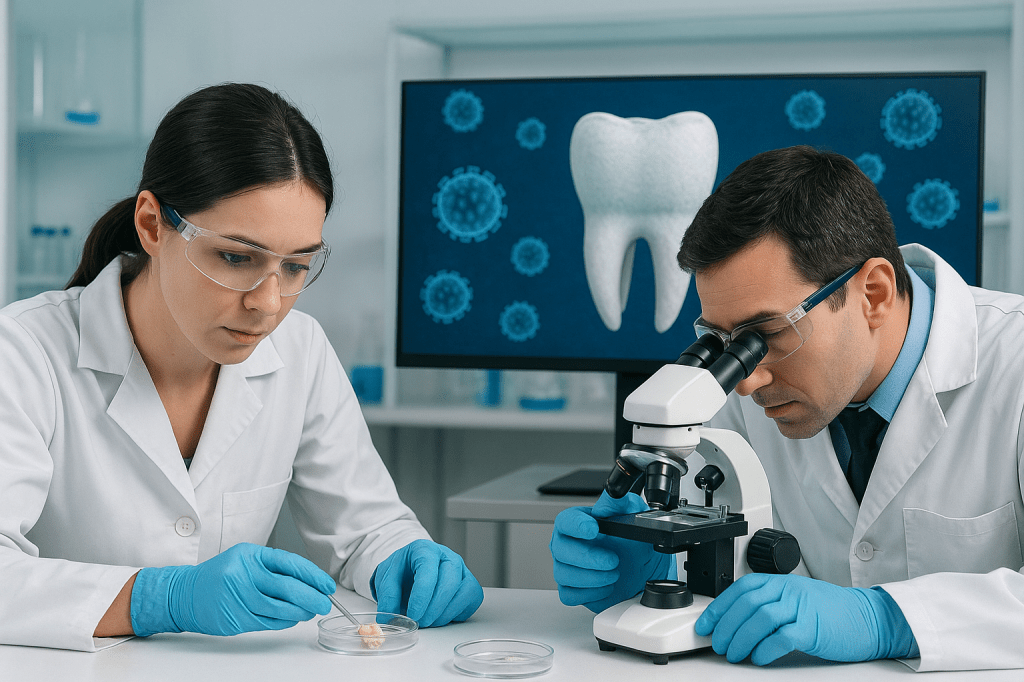
As a profession, we welcome innovation. Many of us would love to see predictable tooth regeneration become a reality. But when it comes to the idea that a fully structured human tooth—complete with enamel, dentin, pulp, periodontal ligament, root morphology, cementum, innervation, and coordinated eruption—can be “grown” on demand…
We are not even close.
Not “five years away.”
Not “a breakthrough around the corner.”
More like: multiple revolutions away in developmental biology, tissue engineering, and immunology.
Why Growing a Tooth Isn’t Like Growing Skin or Bone
Most tissues we regenerate today—bone grafts, soft tissue grafts, even bioprinted cartilage—are structurally simple compared to a tooth. A single functional tooth requires:
- Over 20 distinct cell types
- Perfect timing in signaling pathways (BMP, SHH, Wnt, FGF, etc.)
- Simultaneous development of root + alveolar bone + periodontal ligament
- Epithelial-mesenchymal interactions that mirror embryology
- Correct anatomical form (a molar is not an incisor is not a canine)
- Innervation and vascularization
- Eruption within a specific timeline and direction
- Integration with occlusion and jaw growth
This is not a single tissue.
This is not even a single organ.
A tooth is an orchestrated biologic symphony.
Recreating that symphony outside embryologic conditions is exponentially more complex than the media suggests.
So What Has Been Achieved? (Verified Science)
Here’s the current reality as of 2025:
✔️ Mouse teeth have been bioengineered from stem cells.
Researchers in Japan and the UK have produced rudimentary tooth-like structures in mice. These structures can erupt or be transplanted—but they are far from human-grade in complexity.
✔️ Individual tissues have been grown in isolation.
Enamel-like, dentin-like, or pulp-like tissues have been produced separately in various labs. But none integrate into a full, functional human tooth.
✔️ Certain teams claim “tooth buds” in animal models.
Tooth buds can form, but controlling their shape (bicuspids vs molars), roots, and eruption path remains unsolved.
❌ No functional adult human tooth has been grown from undifferentiated stem cells.
❌ No full human tooth has been grown in a human jaw.
❌ No technology is publicly available or FDA-cleared for tooth regeneration.
Even the researchers publishing these results caution that clinical application is decades away, not “imminent.”
Why the Media Overhypes This
A scientific publication may say:
“We observed early tooth-like differentiation in murine models.”
A media article turns it into:
“Scientists are about to grow new teeth in humans.”
The public reads:
“Dentistry is obsolete next year.”
This is classic hype-cycle distortion—exciting enough for clicks, inaccurate enough to misinform.
How to Explain This Clearly to Patients
Patients aren’t trying to challenge your expertise—they’re reacting to what sounds like a miracle solution. Here’s an easy, professional explanation you can use:
1. Start With Agreement
“Trust me—I wish we could regenerate teeth too.”
Patients relax immediately.
2. Explain It in Simple Biology
“A tooth isn’t one tissue. It’s dozens of cell types developing in a precise sequence. It’s more like trying to grow a mini-organ with its own blood supply, nerves, and bone attachment.”
3. Use an Analogy
“A dental implant is like building a house. Growing a tooth is like trying to grow a living tree from scratch and expecting it to grow in the exact right shape, at the exact right angle.”
4. Reframe Expectations
“We are making progress, but the most advanced work has only created partial tooth structures in animals. A real human tooth with roots and enamel is still far away.”
5. Bring It Back to the Patient’s Needs
“For now, the most predictable way to restore your tooth is X. As soon as true tooth regeneration becomes safe and real, trust me—we’ll all be lining up to offer it.”
Will This Ever Be Possible?
Probably yes—eventually.
But breakthroughs needed include:
- Precision control of stem-cell differentiation
- Molecular signaling timing identical to human development
- Vascular and neural integration
- Root formation
- Safe eruption guidance
- Immune system compatibility
- Prevention of tumor formation (a huge barrier with stem cells)
None of these are solved.
We are still at the “growing a primitive tooth bud in a mouse scaffold” stage—not “growing a premolar #12 in room 3.”
The Bottom Line for Dental Professionals
Dental misinformation spreads fast because it promises simple solutions to complex problems.
The truth is:
- Teeth are not being grown in humans.
- No near-term technology can regrow a full human tooth.
- Implants, prosthetics, and biomaterials remain the standard for decades to come.
But we should celebrate legitimate progress in regenerative dentistry—and keep patients informed with accurate, science-based explanations.
Because when the day finally comes that true tooth regeneration is real, it won’t be a rumor.
It will be one of the biggest medical headlines of the century—and every dentist on earth will know about it.
 Genius Dental Systems
Leave a comment