Most dental offices send surgical patients home with two things:
a handful of gauze and a set of printed instructions.
Technically, that’s all that’s required.
But in reality, the patients who come to us in surgical situations often aren’t “just another appointment.” Many of them have been in significant pain for days. They’ve tried two or three other offices. They’ve spent hours in emergency rooms where no definitive treatment was provided. They arrive exhausted, anxious, frustrated, and sometimes desperate for someone to finally help them.
When you’ve seen that expression—the one that silently says “please, I just need relief”—you start to realize that post-operative care is not a formality.
It’s part of the healing.
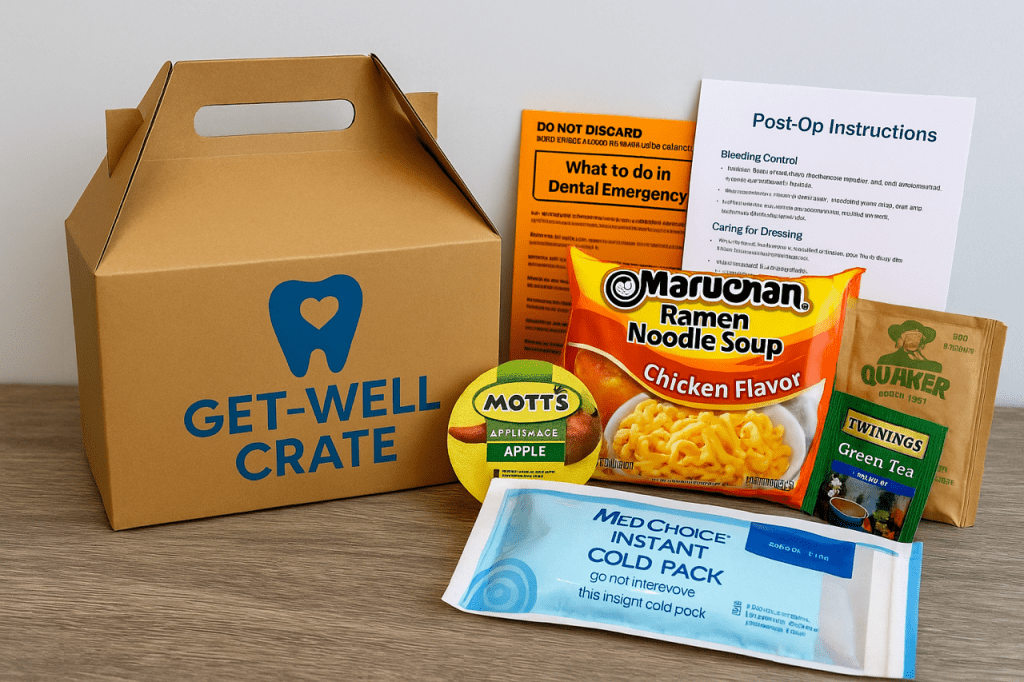
That’s why we created the Get-Well Crate, a recovery box filled with intentional, comfort-focused items to support the first 24 hours after surgery.
It is not required by any dental board.
But it is deeply appreciated by every patient who receives it.
Why This Crate Exists
When someone walks into our office with an acute abscess or severe dental pain, they’ve often been suffering far longer than they admit.
Sometimes:
- they’ve been up all night
- they’ve been told “nothing can be done”
- they’ve tried urgent care, ER, or multiple offices
- they’re swollen, scared, and exhausted
When we perform an extraction or address the infection, the relief is immediate—but it’s only the first step.
Because what comes after—the hours at home—is where patients feel the most vulnerable.
That’s where the Get-Well Crate becomes more than a gesture.
It becomes a continuation of the care we started.
What’s Inside the Get-Well Crate
Inside the box, patients find items chosen for both comfort and practicality:
1. Essential post-op supplies
- Extra gauze
- Clear written instructions
- An emergency contact card
- Instant cold pack
2. Soft foods to get them through the first 24 hours
- Chicken ramen
- Applesauce
- Oatmeal packets
After surgery, most patients can’t chew and aren’t prepared with soft foods.
Providing these removes uncertainty and helps them settle in with confidence.
3. Small comforts that make a big difference
- Tea bags
- A warm drink option
- The cold pack for swelling and comfort
None of this is expensive.
All of it is meaningful.
The Emotional Shift You Can See in Real Time
What surprises people most is not the contents of the crate—but the impact it has on them emotionally.
We’ve had countless patients walk in overwhelmed and in excruciating pain. Their body language tells the whole story: shoulders tense, eyes tired, face swollen, sometimes holding tears back.
When the procedure is complete and they’re handed the Get-Well Crate, something changes.
You can see it in their posture.
You can see it in their face.
You can hear it in their voice.
It’s the moment they realize:
“You didn’t just fix my tooth—
you cared about how I would feel tonight.”
For someone who’s been suffering—or who was scared to come in—that moment matters.
And Then Comes the Phone Call
The crate is only half the experience.
A few hours later, we call each surgical patient.
Not a mass-text.
Not an automated message.
A real call.
We check:
- Did you get your medications?
- Are you taking them correctly?
- How is the swelling?
- Are you in more pain than expected?
- Do you have any questions?
And almost every time, the reaction on the other end is surprise.
They don’t expect a follow-up call.
They don’t expect their doctor to check in personally.
And often you can hear other voices in the background asking:
“Who’s that?”
“Wait—the dentist called you?”
This one gesture extends far beyond the single patient.
Suddenly their spouse, child, coworker, or friend hears the level of care.
The circle of influence widens.
Your reputation grows—not from marketing—but from humanity.
Why This Matters
The Get-Well Crate works because it fills the gap between the clinical part of dentistry and the human part.
To be clear:
The crate doesn’t replace excellent dentistry.
It enhances the experience after excellent dentistry.
Patients remember:
- how you treated them
- how you made them feel
- how you guided them through recovery
- and whether you followed up
This is the stuff that sticks.
This is the stuff that turns a painful emergency into a meaningful patient relationship.
A Practical System Any Office Can Implement
If you run a dental practice, here’s a simple framework to adopt:
1. Use a small box or crate
Simple, but presented with intention.
2. Add soft foods for the first 24 hours
This alone transforms the post-op experience.
3. Provide clear written instructions
Patients forget everything after anesthesia.
4. Include comfort items
Tea, cold packs, etc.
5. Call your surgical patients
This is the real differentiator.
No one forgets the dentist who calls.
Want More Systems Like This?
We’re sharing systems like this — practical, high-impact, patient-centered ideas — on Genius Dental Systems (GeniusDentalSystems.com).
If you believe small touches can create big change in your practice culture, we’re building tools and models to help you do exactly that.
Final Thought
Dental emergencies can be some of the most stressful moments in a patient’s life.
When someone walks into your office in pain, you have two opportunities:
- Relieve the problem
- Restore the person
The Get-Well Crate and the follow-up call help us do both.
They turn fear into relief, pain into gratitude, and a stressful day into a story patients share with the people around them.
And sometimes, those small moments leave the biggest impression of all.
 Genius Dental Systems
Leave a comment